

























Farmers in Rutsiro District have praised newly installed irrigation infrastructure, saying it has allowed them to continue farming during the dry season, increase production, and improve their incomes.

Rwanda experiences four seasons, including rainy and dry periods. The dry season, which runs from June to August, has traditionally discouraged many farmers from engaging in Season C agriculture, often contributing to reduced food availability in November, a period commonly known as Gashogoro.
However, farmers in parts of Rutsiro District, especially in Gihango and Mushonyi sectors, have changed this situation after receiving irrigation systems that allow them to cultivate throughout the year.
ALSO READ: https://agaciropress.com/guarded-by-strong-hands-securing-rwandas-national-exams-under-lock-and-key/
Irrigation Increases Farmers’ Earnings
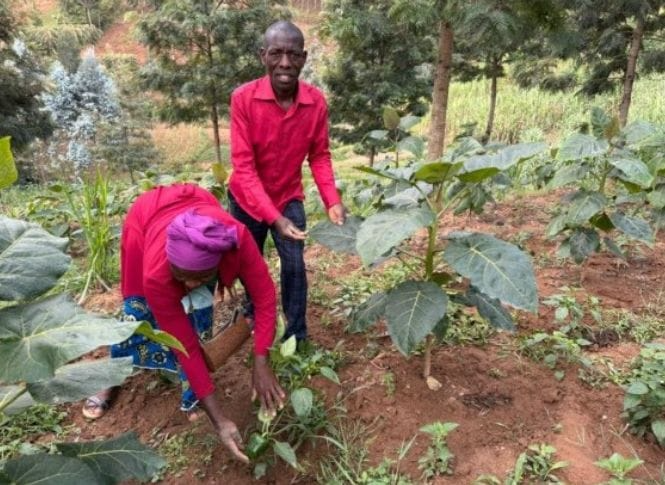
Niyitegeka Cyprien, a farmer from Mushonyi Sector, said irrigation has completely transformed his farming activities.
He explained that during the 2025 dry season, he earned Rwf450,000 from cabbage production on one hectare of land, compared to only Rwf100,000 he previously earned from growing crops such as sweet potatoes during the rainy season.
he said: “We used to grow ordinary crops such as sweet potatoes, cocoyams and cassava, but we faced the effects of climate change. Sometimes we expected rain, only for the sun to shine and our crops to fail. During the dry season, all the hills would be dry, and we would simply sit around without productive activities.”
Today, despite the ongoing dry season, Niyitegeka’s farm is producing 1,300 tomato plants and 2,500 bell pepper plants. He expects to earn about Rwf12 million from tomatoes and Rwf2 million from bell peppers thanks to reliable access to water.
he said: “Looking at how things were before this water was brought and how they are now, we believe that if water reaches different parts of the country, the problem of hunger could eventually be completely solved.”
More Farmers Join Dry-Season Agriculture
Bambuzurwaho Razaro, leader of Tuzamurane farmers’ group, which has 37 members, said farmers were initially reluctant to cultivate during the dry season after an irrigation pipeline connected to the Nangumurimbo River was installed by the environmental organisation ARCOS.
“At first, only two farmers cultivated. The others were afraid. I planted green beans and earned Rwf400,000, while Niyitegeka grew cabbages and earned Rwf450,000. This encouraged other farmers to start farming during the dry season. This season, more than 30 farmers are cultivating,” he said.
According to Aimable Hategekimana, an ARCOS staff member responsible for general operations and administration, the Mushonyi irrigation pipeline complements another system installed in Gihango Sector.
He explained that both irrigation systems are environmentally friendly because they use natural water flow through pipelines instead of diesel-powered pumping machines.
ALSO READ: https://agaciropress.com/rwandan-peacekeepers-provide-free-medical-care-to-prisoners-in-car/
Irrigation Expands Farming Areas in Rutsiro
Rutsiro Vice Mayor in charge of Economic Development, Uwizeyimana Emmanuel, said irrigation systems have increased the area cultivated during the dry season in the district.
He noted that farmland under dry-season cultivation has grown from 50 hectares two years ago to 85 hectares today.
he said: “We urge residents to properly maintain these irrigation systems and grow fast-maturing, high-value crops so that they can farm during all three seasons.”
Rutsiro is among Rwanda’s mountainous districts, where irrigating farms located on higher terrain has always been challenging. However, farmers believe these interventions will play an important role in achieving food self sufficiency.
ALSO READ: https://agaciropress.com/rayon-sports-unveils-2026-27-squad-at-kigali-pele-stadium/
Government Expands Irrigation Support
The Government of Rwanda has set a target of increasing agricultural and livestock production by 50% by 2029 as part of efforts to strengthen food security and promote economic growth.
As part of this strategy, Rwanda plans to expand irrigated farmland from more than 74,375 hectares to 132,171 hectares by 2029.
To support small-scale farmers, the government provides subsidies covering 50% of the cost of irrigation equipment for farms of up to 10 hectares, while farmers contribute the remaining half.
Through expanded irrigation, farmers like those in Rutsiro are increasingly able to overcome the challenges of climate change, produce throughout the year, and improve their household incomes.