































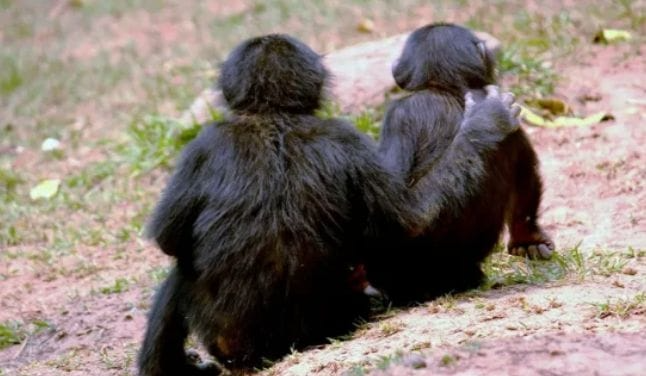
A new study has found that great apes, including chimpanzees and bonobos, use hugging, physical contact and kissing to strengthen social bonds and reduce conflict within their groups.

Researchers Observe Social Bonding Behaviors
Researchers from Durham University in the United Kingdom studied the behavior of these primates and discovered that before situations likely to trigger B disputesparticularly during food sharing they engage in physical contact to calm one another and reinforce trust.
The study was conducted on chimpanzees and bonobos living in two ape sanctuaries in the Democratic Republic of the Congo and Zambia. Researchers recreated a food-sharing scenario similar to what the animals experience in the wild by using peanuts to observe their behavior before feeding.
ALSO READ: https://agaciropress.com/omans-salamair-launches-flights-to-kigali/
Hugging and Kissing Promote Peaceful Food Sharing
The findings showed that the apes displayed a variety of affiliative behaviors, including hugging, touching, grooming and kissing, particularly in the minutes leading up to feeding time. According to the research team, these interactions helped strengthen trust among group members and enabled them to share food more peacefully.
One of the study’s most surprising findings was that chimpanzees, despite their reputation for displaying aggressive behavior, also showed remarkable signs of affection and trust. In some cases, they were observed placing their fingers into another chimpanzee’s mouth a behavior interpreted as a strong display of confidence and mutual trust.
ALSO READ: https://agaciropress.com/kamonyi-man-found-dead-in-house-investigation-launched/
Researchers Compare Behavior to Team Huddles
Professor Zanna Clay, one of the lead researchers, said that before potentially stressful events, the animals instinctively come together, comfort one another through physical contact and embrace. She compared the behavior to American football players gathering in a team huddle before a major game.
The researchers also found that ape groups characterized by greater social tolerance were more likely to engage in these bonding behaviors. They observed what they described as “reassurance trains,” in which several apes sequentially hugged one another as a way of reinforcing group unity.
Study Offers New Insight into Human Evolution
Dr. Jake Brooker, another member of the research team, said physical touch is one of the oldest forms of communication and may have existed long before spoken language evolved. The researchers believe this use of touch to build trust and cooperation could date back at least seven million years.
The study was published in the scientific journal Proceedings of the Royal Society B: Biological Sciences and provides new insights into the social lives of humanity’s closest animal relatives, shedding light on how they maintain cooperation, manage conflict and strengthen relationships within their communities.