
































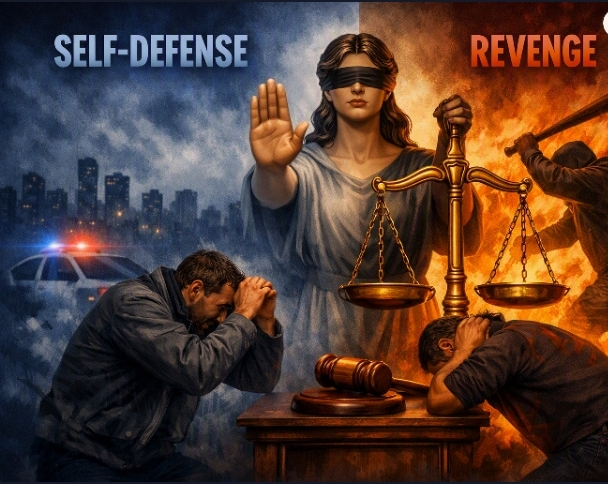
Self-defense can sometimes result in injuring or even killing an attacker, but whether the law considers such an act a crime depends on specific circumstances.

The law recognizes self defense, but not every act of violence can be justified in its name. Certain legal requirements must be met before an act can be considered lawful self-defense.
The Attack Must Be Unlawful
The attack must be unlawful, such as an attempt to beat, injure, kill, rape, or otherwise harm another person. A person cannot start a fight and later claim self-defense simply because the other person responds.
Self-defense is intended to protect someone from an unlawful attack, rather than provide a justification for violence after voluntarily entering into a confrontation.
The Danger Must Be Immediate
The attack must either be happening or be imminent. Past threats alone are generally not enough. The danger must be present or very near, requiring immediate action to prevent injury or death.
For example, if someone is chasing you with a knife, the danger is real and immediate. However, if you find that person the next day and beat them because of what happened earlier, that would be revenge rather than self-defense.
The Force Used Must Be Necessary
The force used in self-defense must be necessary to stop the attack. Courts may consider whether there were other ways to escape the danger, although they also recognize that a person facing an immediate threat may not have enough time to calmly consider every possible option.
Factors such as fear, the weapon used, the number of attackers, and the seriousness of the danger may all be considered when determining whether the response was justified.
Killing in Self-Defense Is Not Automatically Justified
Killing an attacker does not automatically mean that the person who caused the death acted lawfully. A detailed investigation may be carried out to establish how the attack began, who was involved, what weapons were present, where and when the incident happened, and the nature of the injuries.
Evidence such as witness testimony, video recordings, audio recordings, and messages may be examined. If the attacker was no longer capable of continuing the assault, using further force could be considered revenge rather than self-defense.
Self-Defense Ends When the Attack Ends
Self-defense generally ends when the danger has ended. If the attacker flees, falls down, loses the ability to continue, or is disarmed, continuing to use violence may no longer be considered self-defense.
Simply saying, “I hit him because he attacked me first,” is not enough. It must be established that a real and immediate danger still existed when the force was used.
Protecting Another Person
Self-defense can also apply when protecting another person from an unlawful attack. A person may intervene to stop someone from being beaten, strangled, or seriously harmed.
However, the intervention must still involve the necessary force required to stop the attack. Excessive violence may not be protected as self-defense.
Protecting Property Has Limits
The protection of property also has limits. The law may allow reasonable measures to prevent theft or damage, but human life is generally valued more highly than property.
Using deadly force to protect property of little value may therefore be considered excessive. Investigators and courts may consider the circumstances of the theft or damage, whether the person was armed, and the level of danger posed to people.
ALSO READ: https://agaciropress.com/ishimwe-vestine-begins-divorce-process-citing-husbands-infidelity/
Self-Defense Is Different From Revenge
The main difference between self-defense and revenge lies in the timing and purpose of the action.
Self-defense aims to stop an ongoing or imminent attack, while revenge seeks to punish someone for something they have already done. If the conditions for self-defense are satisfied, the act may not be considered a crime.
However, if the force used goes beyond what was necessary or continues after the danger has ended, the person involved may face prosecution.
ALSO READ: https://agaciropress.com/rwandan-investors-can-now-buy-shares-in-dangote-refinery/
Evidence Is Crucial
Evidence can play an important role after an incident involving self-defense. A person involved in such an incident should not flee, hide weapons, or alter the scene, as doing so can complicate the investigation and the search for the truth.
Ultimately, self-defense does not give anyone permission to take revenge. There must be a real unlawful attack, an immediate danger, and force that is necessary to stop the threat without exceeding the seriousness of the danger.