























The Government of Rwanda has continued to strengthen the livestock sector, including aquaculture, as part of its efforts to boost food production and economic growth. According to the Ministry of Agriculture and Animal Resources, fish production increased significantly during the 2024/25 fiscal year, reaching 52,439 tonnes in 2025, up from 43,133 tonnes in 2024.

The figures indicate a 34% increase in fish production, with 71.6 million fingerlings produced during the past year. Rwanda aims to increase its annual fish production to 80,620 tonnes by 2035.
Fine Fish Expands Investment
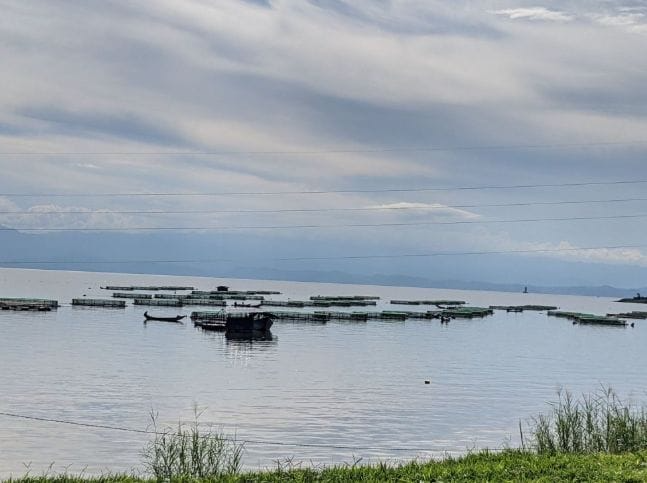
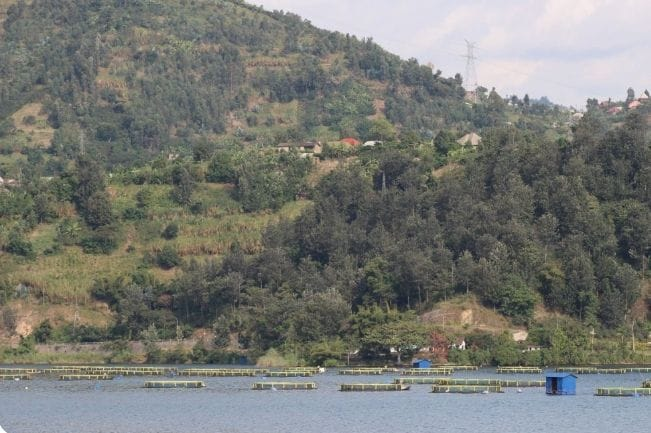
Among the companies driving the growth of aquaculture is Fine Fish, which operates fish farms on Lake Kivu across a 90-hectare area in the bays of Rubavu District. The company began operations in 2017 with an initial investment of Rwf300 million, which had grown to Rwf3 billion by early 2026.
Fine Fish started with 10 traditional bamboo floating cages in 2017 and harvested 60 tonnes of fish during its first year, selling them at Rwf3,500 per kilogram. Today, the company produces 3,000 tonnes of fish annually.
ALSO READ: https://agaciropress.com/kagugu-armored-vehicle-battle-inspires-youth-to-counter-genocide-denial/
Ambitious Growth Plans
The largest fish harvested from Fine Fish’s cages weigh up to 1.5 kilograms, while the smallest weigh around 200 grams. Every day, the company feeds its fish 15 tonnes of feed valued at Rwf18 million. It employs 140 workers, of whom 11% are women.
Fine Fish General Manager Muhirwa Charles said the company has made remarkable progress and plans to further expand production.
He said: “We will continue expanding our fish farming operations because our goal is to increase annual production from the current 3,000 tonnes to 12,000 tonnes within the next five years
Challenges Facing the Sector
Muhirwa noted that the company still faces several challenges, including the high cost and delayed delivery of imported materials used to construct floating cages, as well as the rising prices of raw materials used in fish feed production.
Improving Livelihoods and Local Business
Niyonsaba Emile, who has worked with Fine Fish for the past nine years, said the company has transformed his life.
He said: “After completing secondary school, I applied for a job and was hired to care for the fish and help market the harvest. Today, I am married with a child. I have been able to buy a plot of land worth Rwf4 million and I am building a house valued at Rwf7 million.”
Rusakara Jean d’Amour, manager of a bar and restaurant serving customers in Rubavu, said Fine Fish has made it much easier for businesses to access fresh fish.
he said: “Fine Fish has brought the supply closer to us, making it easy to get freshly harvested fish whenever we need them. As business operators, we no longer worry about disappointing customers because of fish shortages. In the past, we had to buy large quantities and store them in freezers.”

ALSO READ: https://agaciropress.com/ukraine-rejects-claims-that-it-supports-the-m23-rebel-group/
Modern Fish Farming Facilities
Today, Fine Fish has developed the capacity to produce its own fingerlings. The company operates 150 floating cages, each with a capacity of 200 cubic metres, where fingerlings weighing less than 50 grams are raised.
It also has 60 floating cages, each with a capacity of 470 cubic metres, and 15 larger cages with a capacity of 900 cubic metres each. These are used to raise fish from 50 grams to a market weight of 1.5 kilograms.
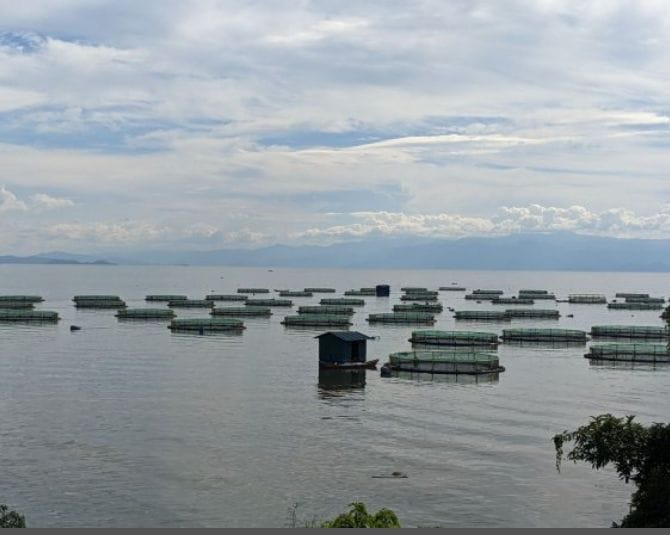
Fine Fish’s Aquaculture Operations Continue to Expand.