

















Rwanda’s Minister of Foreign Affairs and International Cooperation, Ambassador Olivier Nduhungirehe, has warned the United States that what he described as biased sanctions will not help resolve the conflict between Rwanda and the Democratic Republic of the Congo (DRC), but will instead deepen tensions.

Washington Peace Agreement Faces Implementation Challenges
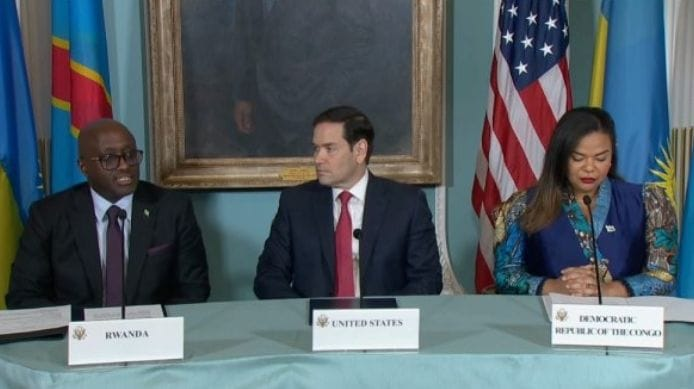
On June 27, 2025, Rwanda and the DRC signed a peace agreement brokered by the United States. Among its key provisions were the DRC’s commitment to dismantle the FDLR, a genocidal terrorist group, while Rwanda agreed to lift the defensive measures it had put in place once the agreed conditions were met.
On December 4, 2025, Rwandan President Paul Kagame, DRC President Félix Tshisekedi, and U.S. President Donald Trump attended a ceremony in Washington, D.C., where they signed a follow-up agreement incorporating regional economic cooperation as an additional pillar of the peace process.
Rwanda Says the DRC Has Failed to Honor Its Commitments
In an interview with France 24 journalist Marc Perelman, Minister Nduhungirehe argued that the Washington peace agreement had failed to produce the expected results because the DRC had repeatedly violated the ceasefire, continued to support the FDLR, and hosted individuals opposed to the Rwandan government, including Jean Luc Habyarimana, the son of former President Juvénal Habyarimana.
The minister noted that on June 5, 2026, U.S. Secretary of State Marco Rubio acknowledged before members of Congress that Rwanda was complying with the agreement, while the DRC had taken no meaningful steps toward implementing its commitments, reflecting what he described as a lack of political will.
He said: “On June 5, Marco Rubio told the congressional committee that Rwanda was complying with the agreement. But what did he say about the other party? He said the other side had done nothing, not even begun implementing the agreement. Peace agreements are signed by two parties, not by Rwanda alone,”
Responding to Rubio’s statement expressing hope that Rwanda would lift its defensive measures by mid-July 2026, Nduhungirehe clarified that no deadline had been imposed by the United States.
He explained: “First of all, the United States did not set any deadline. It was Rwanda that proposed a roadmap aimed at accelerating the implementation of the Washington Peace Agreement for peace and development, outlining how both parties could fulfill their respective commitments more quickly.”
The minister stressed that Rwanda had demonstrated its readiness to lift its defensive measures, but insisted that the DRC must first fulfill its own obligations by ending hostilities and dismantling the FDLR.
Minister Questions U.S. Sanctions and Mediation
Nduhungirehe recalled that on June 26, 2026, President Trump’s Senior Adviser for Africa, Massad Boulos, told the United Nations Security Council that the DRC had failed to dismantle the FDLR, even in areas under its control. He questioned why Rwanda continued to face sanctions despite those findings.
He said: “Last Friday, the United States itself acknowledged that the Congolese government had not dismantled the FDLR. We are concerned that the U.S. mediation is becoming increasingly one-sided. Two parties signed the agreement, and both have obligations,”
Commenting on the U.S. sanctions imposed on Gasabo Gold Refinery, its management, and several mining companies on June 25, the minister argued that such measures would do nothing to resolve the dispute between Rwanda and the DRC.
He said: “First and foremost, these sanctions are biased. They target only one side and will not produce any positive outcome. Imposing sanctions is not the role of a mediator. If a mediator believes sanctions are necessary, applying them to only one party merely encourages the other,”
He added that Rwanda had signed an agreement with the DRC, which committed itself to ending hostilities and dismantling the FDLR: “Peace cannot be achieved if only one side is expected to fulfill its obligations under the agreement.”
Rwanda Raises Concerns Over Ceasefire Violations
According to the minister, the consequences of what he described as biased mediation are already becoming evident. He alleged that Congolese forces have intensified attacks against the Banyamulenge community in Minembwe Commune and against AFC/M23 positions because President Félix Tshisekedi believes the United States will not hold his government accountable.
He asked: “How many civilians must die before it is recognized that the DRC should also be required to respect the ceasefire?”
He added: “Continuing down this path is dangerous. We should return to the negotiating table, with each party honoring the commitments it made under the agreement,”
Dispute Continues More Than a Year After the Agreement
More than a year has passed since the Washington Peace Agreement was signed. The agreement stipulated that the dismantling of the FDLR would precede Rwanda’s withdrawal of its defensive measures, with both actions expected to be completed within 90 days. While the Congolese government maintains that it has dismantled the FDLR, Rwanda argues that this claim is false.
On March 2, 2026, the United States imposed sanctions on members of the Rwanda Defence Force (RDF) and their commanders, accusing them of violating the Washington Peace Agreement. When it later sanctioned Gasabo Gold Refinery and several mining companies, it did not impose any measures on the Congolese government.