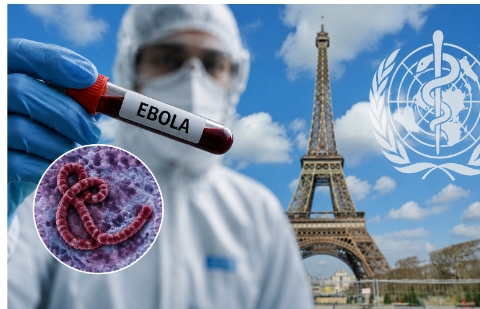













France has confirmed its first Ebola case linked to the current outbreak, involving a doctor who recently returned from a humanitarian mission in the Democratic Republic of Congo (DRC). The French Ministry of Health announced that the doctor was immediately placed in isolation at a specialized facility for highly infectious diseases. Authorities said the doctor’s condition is stable.

ALSO READ: HUYE: Residents of Rwaniro Welcome Electricity Project Expected to Accelerate Development
DRC Outbreak Continues to Worsen
The Ebola outbreak in the DRC was officially reported last month, though health experts believe the virus may have been spreading for several weeks before it was detected. Since then, the outbreak has grown significantly, with more than 1,000 infections recorded and over 260 deaths reported. Most cases have been concentrated in the eastern provinces of Ituri, North Kivu, and South Kivu, with Ituri accounting for more than 90% of confirmed infections.
Ebola Cases Spread Beyond DRC
France’s case marks the first confirmed Ebola infection in Europe connected to this outbreak. However, it is not the first case outside the DRC, as an American doctor who contracted the disease in the DRC was treated in Germany last month. Uganda has also reported cases within its borders. According to the World Health Organization (WHO), Uganda has so far confirmed 20 cases and two deaths.
Health Authorities Increase Monitoring and Contact Tracing
French health officials have emphasized that the risk of transmission to the general public remains very low. Nevertheless, contact tracing has already begun to identify anyone who may have been exposed to the infected doctor. France has also introduced special monitoring measures for aid workers returning from the DRC. Healthcare workers remain among the most vulnerable, as Ebola spreads through direct contact with the bodily fluids of infected individuals.
No Approved Vaccine Yet for the Bundibugyo Strain
The current outbreak has been linked to the Bundibugyo strain of the Ebola virus, for which there is currently no approved vaccine. Both the Africa Centres for Disease Control and Prevention (Africa CDC) and United States health authorities have warned that the outbreak could become one of the most serious in recent years. The WHO has also noted that ongoing insecurity and conflict in eastern DRC are continuing to hamper efforts to contain the virus and provide treatment.