




























The 2026 National Agriculture and Livestock Exhibition, held in Kigali from July 23 to 30, attracted one of its largest turnouts yet, with more than 600 exhibitors from Rwanda and abroad, up from about 500 exhibitors who participated last year.

Held annually at Mulindi in Kigali, the exhibition brings together participants from different regions to showcase innovations in agriculture and livestock, including agricultural produce, value addition, modern technologies, farming equipment, and other solutions that help farmers access new markets and build business partnerships.
The Ministry of Agriculture and Animal Resources, which organizes the exhibition, noted that the number of exhibitors has continued to grow. Five years ago, the event featured around 300 exhibitors, including individuals, cooperatives, and companies.
Several exhibitors who spoke to IGIHE said the exhibition has played a significant role in promoting innovation in agriculture and livestock while providing them with valuable opportunities to market their products and technologies.
Hydroponic Farming Offers Soil-Free Crop Production
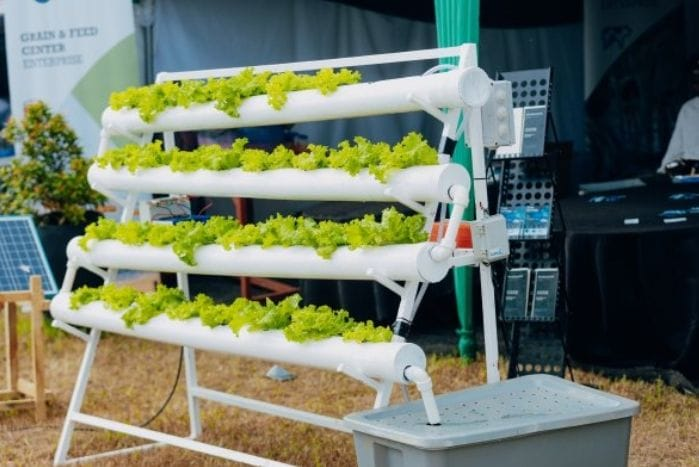
Among the exhibitors was Yves Kayiranga, a recent university graduate in agriculture and animal husbandry, who showcased a hydroponic farming system that allows crops to be grown without soil.
Hydroponic farming uses nutrient-rich water instead of soil to cultivate crops such as vegetables.
The system consists of perforated plastic pipes fitted with small cups that hold plant roots while allowing them to come into contact with flowing nutrient-rich water.
The water is stored in a nearby reservoir containing all the nutrients required for plant growth and is continuously circulated through the system using a pumping mechanism. The pipes are arranged vertically, allowing crops to be grown several meters above the ground, significantly increasing production capacity without requiring large areas of land.
The technology can be powered by either solar energy or the national electricity grid and is equipped with digital monitoring systems that enable farmers to use smartphones or computers to track the needs of their crops.
Kayiranga said hydroponic farming is widely practiced in countries such as Saudi Arabia, Israel, Singapore, and Japan, and believes it could help Rwanda modernize agriculture despite limited land resources.
He said: “On one square meter, conventional farming can accommodate about 40 plants, but with this technology that number can rise to around 300 plants. Compared to traditional farming, the same production would require more than three times the land because our system grows vertically. We want to make this technology accessible to Rwandans so they can continue farming regardless of climate change,”
Poultry Innovation Cuts Costs and Improves Chick Health
Another exhibitor, Emmanuel Mbonyingabo, founder of Mbonyingabo Poultry Farms in Nyabihu District, presented an automated chick-heating system developed after years of experience in poultry farming.
Traditionally, poultry farmers keep newly hatched chicks warm by using charcoal stoves that burn continuously. Mbonyingabo said he designed a more efficient and safer alternative to address the challenges associated with that practice.
He explained: “I spent years raising poultry and realized that keeping chicks warm was one of the biggest challenges. In May 2025, I developed a technology that uses special lamps to provide both heat and light while also improving ventilation inside poultry houses. The system automatically detects when additional heat is needed and adjusts accordingly,” he explained.
He noted that the innovation significantly reduces operating costs, as heating a poultry house with charcoal typically costs around Frw100,000, while the new system uses electricity costing less than Frw50,000.
The technology also reduces poultry diseases by limiting unnecessary human movement into poultry houses to tend charcoal stoves. It further eliminates exposure to ammonia and other harmful substances produced by burning charcoal, which can damage the respiratory health of chicks. Mbonyingabo said many poultry farmers have already started adopting the innovation.
Cassava Farming Technique Delivers Higher Yields
Cassava farmer Seraphine Mukandutiye from Bugesera District also showcased an improved cassava cultivation technique that enables farmers to achieve exceptionally high yields on small plots of land.
She explained that the method was introduced through the Terepa project implemented by the International Union for Conservation of Nature (IUCN). The approach combines cassava cultivation with agroforestry, where cassava is planted in large pits filled with a mixture of soil and organic fertilizer alongside trees, resulting in significantly higher productivity.
“I cultivate just half a hectare, and cassava takes about two years to mature. By the time it is ready for harvest, I also earn income from the other crops planted alongside it, generating around Frw2.5 million. Today, a single cassava plant produces between 60 and 80 kilograms, compared to only five to ten kilograms under conventional farming. Thanks to these earnings, I have started raising 250 chickens and opened a roadside shop,” she said.
Exhibition Continues to Drive Agricultural Innovation
The exhibition continues to serve as a platform for farmers, innovators, cooperatives, and companies to showcase technologies that improve productivity, reduce production costs, promote climate-smart agriculture, and strengthen market access across Rwanda’s agriculture and livestock sectors.