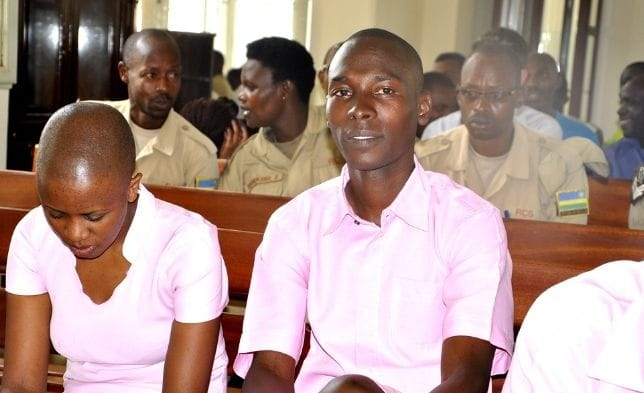



























In the trial of Ingabire Umuhoza Victoire and nine others, which has been ongoing at the High Court in Kigali since September 18, 2026, the Prosecution presented evidence detailing an alleged plan to overthrow the Rwandan government.

The evidence included recordings of two conversations Ingabire held in May 2020 with journalist Ntamuhanga Cassien, who fled Rwanda to evade justice. One conversation concerned military training, while the other discussed a planned demonstration at a major roundabout in Kigali.
During an audio recording played in court on September 21, Ntamuhanga is heard telling Ingabire about “Tura Tugabane.” Ingabire asks whether there was sufficient capacity to develop a plan to overthrow the government, to which Ntamuhanga responds that the Sankara group had withdrawn because they first needed to create chaos.
Ntamuhanga is heard using coded language, including references to “weighing heavy scales” and small metal objects. The Prosecution interpreted these expressions as referring to “heavy weapons” and “grenades.”
The journalist is also heard saying that “men from the feet of Africa” would participate. The Prosecution interpreted this as referring to people including Kayumba Nyamwasa, who lives in South Africa.
The Prosecutor explained that Ntamuhanga and Ingabire were discussing training fighters in Mutaga, Burundi, and that Ingabire asked him to contact a person named Placide so they could further develop the plan.
Ingabire Challenges Recordings and Denies Agreement
On October 1, 2026, Ingabire told the court that she had been illegally recorded during the May 2020 conversations because those who made the recordings had not obtained the required authorization.
Regarding the audio recording about Burundi and Mutaga, Ingabire said: “In that audio about Burundi and Mutaga, nowhere did I tell Cassien that I agreed with what he was telling me. Let them examine those coded statements and determine whether they were mine or Cassien’s. I told Cassien that I was not available.”
She told the court that Ntamuhanga had called her and they had a conversation, but that they had never agreed on the matters he was discussing with her. She explained that directing him to Placide, who lives in Belgium, was intended to distance herself from the alleged plan.
Ingabire said she spoke with Ntamuhanga despite the fact that he had fled justice and was opposed to the Rwandan government because, as a politician, she believed she needed information about different people to understand which side they stood on.
she said: “President, in politics, you need to know all the information. Where do you stand? What is your position? What are others thinking? What are they doing?”
The presiding judge asked Ingabire whether Ntamuhanga was a politician. She responded that he was a politician affiliated with a party called “RANP Abaryankuna.”
Recording Details Alleged Demonstration Plan in Kigali
Another recording played in court on September 22 captured Ntamuhanga telling Ingabire that they had three motorcycle taxi riders who “knew how to ride.” She responded that they could get 10 motorcycle taxi riders from Nyabugogo, 10 from Remera, 10 from Muhima and 10 from Nyamirambo, bringing the total to 50.
Ingabire is heard saying that these motorcycle taxi riders could be joined by others from different areas, after which “a vehicle fitted with a loudspeaker” would arrive at the roundabout and break down there. Shortly afterwards, it would play a song by the late Kizito Mihigo.
She is heard saying that once this happened, roads leading to the main roundabout in central Kigali would be blocked, leaving only the roads leading to Hotel Mille Collines and UTC open, while people would gather to see what had happened.
Ntamuhanga responded that the plan would be very serious and therefore required caution. He then added to Ingabire’s suggestion that the vehicle used in the demonstration could resemble “that cargo vehicle used to transport fish.”
he said: “The vehicle would have a cargo compartment, very securely closed. Then inside there would be something like a generator, I don’t know,”.
Ingabire is heard saying that the demonstration would begin at 9 a.m. and that the vehicle, initially parked somewhere nearby, such as Saint-Famille, would go to the roundabout and “get stuck there,” causing the roads to be blocked.
She said that when the vehicle broke down, people would gather to see what was happening, while people who knew what needed to be done would be present and one of the popular songs by the late Kizito Mihigo would be played.
Ingabire is heard saying that the plan should be properly organized in July 2020 rather than being something arranged “in a week.” She also told Ntamuhanga that the world was beginning to wake up because of the COVID-19 pandemic.
Ingabire Says COVID-19 Discussion Was Not an Agreement
On October 1, Ingabire told the court that the conversation was about “the impact of COVID-19 on governing institutions in some countries” and had started from a report published in France on the impact of the pandemic on countries.
She said: “At the time we were talking, we were discussing, ‘If you wanted to expose the weaknesses of a government, how would you expose them in relation to this issue concerning COVID-19?’ That is when we began discussing the issue of the food they were distributing.”
Ingabire said her conversation with Ntamuhanga ended in a debate and that they never reached an agreement to implement what they had discussed.
she said: “What happened was that we were discussing based on that report. Nowhere did we conclude by saying that we were going to do this, for the Prosecution to use it as a basis to say that Ingabire and Cassien had agreed to establish a criminal group,”
Ingabire further argued that if Ntamuhanga Cassien had been a member of DALFA Umurinzi, the Prosecution could have relied on that to argue that they shared a common plan to harm the government.