




























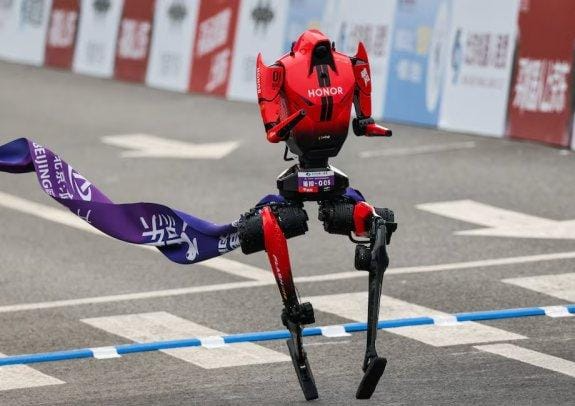
A humanoid robot developed by Chinese technology company Honor has reportedly run 100 metres in 9.32 seconds, beating the 9.58-second world record set by Jamaican sprinter Usain Bolt in 2009.

ALSO READ: https://agaciropress.com/ruhango-dispute-erupts-between-residents-and-sand-miners-over-land/
Robot Reaches 14.5 Metres per Second
The robot, named Lightning, recorded the time during a trial on Saturday ahead of the Second World Robot Games in Beijing, China.
Lightning reached a top speed of 14.5 metres per second during the run.
Its recorded time of 9.32 seconds was faster than Bolt’s men’s 100-metre world record of 9.58 seconds, set at the 2009 World Athletics Championships in Berlin, Germany.
Robot’s Run Was Part of Competition Preparations
Lightning’s performance was conducted as part of preparations for robot competitions, where researchers are testing and improving the robot’s physical capabilities.
The robot’s performance demonstrates the rapid development of humanoid robotics as researchers work to create machines capable of performing tasks that traditionally require human physical abilities.
ALSO READ: https://agaciropress.com/rwanda-drc-and-burundi-discuss-reparations-for-belgian-colonial-damage/
Lightning Previously Won a 21-Kilometre Race
Lightning had already attracted attention in April 2026 when it won a 21-kilometre race in Beijing, finishing in 50 minutes and 26 seconds.
At the time, the robot was 169 centimetres tall, with legs measuring 95 centimetres.
Researchers later extended its legs by 10 centimetres to 1.05 metres in an effort to improve its performance ahead of major robot competitions.
ALSO READ: https://agaciropress.com/kenya-two-farmers-arrested-over-suspected-poisoning-of-elephants/
China Expands Investment in Humanoid Robots
China continues to invest heavily in humanoid robotics, with the technology expected to play an important role in industries such as manufacturing, transportation and other services.
The development of robots capable of running at high speeds highlights the rapid progress being made in machines designed to imitate human movement and abilities.
Researchers are continuing to improve these robots so they can perform a wider range of tasks with greater speed, balance and efficiency.