










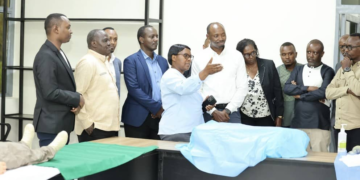





















The Director General of the National Examination and School Inspection Authority (NESA), Dr. Bernard Bahati, commended key partners involved in the development of CAMIS 2.0, notably Educate! and Innovations for Poverty Action (IPA). He praised their strong collaboration and sustained support throughout the system’s development process.

ALSO READ: Kagame Receives AU Mediator Faure Gnassingbé at Village Urugwiro
Partners’ Role in Strengthening Data Systems
Dr. Bahati noted that the contributions of the partners were instrumental in enhancing CAMIS 2.0’s capacity to collect, analyze, and utilize education data effectively. Their technical and institutional support played a critical role in strengthening the system’s overall functionality.
The Director General of NESA, Dr. Bernard Bahati, stated that the journey is still long, but the achievements made so far give hope that more successes will be realized.
He said: “At the beginning, it was difficult, but from the challenges we encountered, we learned many lessons that helped us reach where we are today. The journey is still long, but the progress achieved gives us confidence that more successes will follow.”
CAMIS 2.0 as a Decision-Making Tool
He emphasized that CAMIS 2.0 is a robust digital platform designed to support education stakeholders in making informed, evidence-based decisions. The system enables the use of accurate data and reliable statistics, particularly those related to students’ academic performance.
Improving Monitoring, Planning, and Policy
According to Dr. Bahati, CAMIS 2.0 will significantly improve monitoring and evaluation processes within the education sector. He added that the platform will also enhance planning and policy formulation, contributing to improved service delivery and accountability.
A Milestone in Education Technology Integration
In conclusion, Dr. Bahati described CAMIS 2.0 as a major milestone in integrating technology into Rwanda’s education sector. He stated that the system reinforces the country’s commitment to data-driven decision-making and continuous improvement in learning outcomes.