












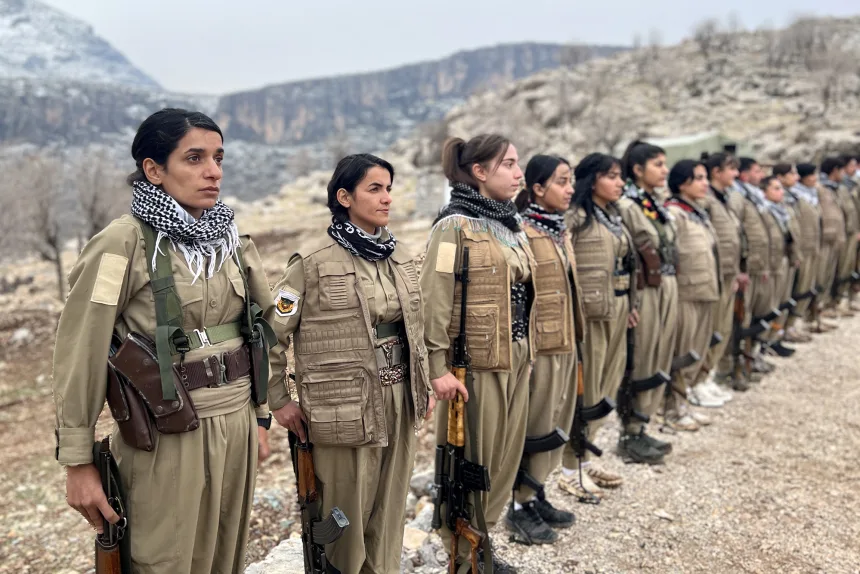
In the rugged mountains of northeastern Iraq, a young Kurdish fighter struggles to reassemble his AK-47 during a training drill. Surrounded by fellow recruits, commanders, and a CNN crew, his discomfort draws light laughter. His instructor calmly hands him another rifle and asks him to try again.

“These fighters are still new,” explains Karim Farkhapur, a senior figure in the Kurdistan Democratic Party of Iran (KDPI), as training continues at a remote camp just over 20 kilometers from the Iranian border.
A Long Struggle Against Tehran
Founded in 1945, the KDPI is the oldest and largest Kurdish opposition group in Iran. It has spent decades fighting first against Iran’s monarchy and later against the Islamic Republic established after the 1979 revolution.
Iranian Kurds, who make up roughly 10% of the country’s population, are among several ethnic groups—including Baluch and Arabs—who have pushed for autonomy or independence. Other opposition movements challenge Tehran on ideological grounds, and many receive varying degrees of foreign support.
Protests Renew Hope for Change
Recent nationwide protests in Iran have raised expectations among Kurdish groups that the ruling system may be weakening.
Mustafa Hijri, the KDPI’s leader, says the government’s declining strength has created opportunities for opposition forces. He claims the party has extensive networks inside Iran and played an important role in supporting protests, especially in western Kurdish regions.
Women on the Front Lines
Among the new recruits is Farina, a 19-year-old woman carrying a Dragunov sniper rifle. She says she fled Iran after losing hope for a meaningful future.
According to Farina, opportunities in Iran are limited unless one supports the ruling system, and women face even greater restrictions. Joining the peshmerga, she says, allows her to defend both her Kurdish identity and her rights as a woman.
Like many Kurdish movements across the region, the KDPI includes both men and women in combat roles and emphasizes gender equality as a core principle.
Mountains: Refuge and Risk
The saying that “the Kurds have no friends but the mountains” feels especially real in the isolated, snow-covered terrain where these fighters operate. The harsh environment offers protection and seclusion—but also vulnerability.
Farkhapur notes that Iranian drones regularly fly over the camps, fully aware of their location. In recent years, Iran has launched strikes against Kurdish bases in northern Iraq, and such attacks could happen again.
Life Chosen with Sacrifice in Mind
For generations, Iranian Kurds have crossed these mountains seeking freedom and change. Life in the camps is cold, demanding, and dangerous.
Yet for fighters like Farina, the risk is accepted.
“We chose this path knowing it could cost us our lives,” she says. “Sacrifice is something we are prepared for.”









Comments 1